

Ricky Hatton (1978–2026)

here’s a moment, early on in “Hatton”, the 2023 documentary covering the life and career of British boxer Ricky Hatton, in which he delivers a line that at the time seemed poignant but now lands with the weight of one of his signature body shots. “I was a world champion four times over, but I consider myself a failure,” he said. “It wasn’t supposed to end this way.”
After reports emerged on Sunday morning that the 46-year-old had died at his home in the town of Hyde in Greater Manchester, it sparked a deluge of tributes for a man who delivered some of British boxing’s most memorable moments, winning world titles in two weight classes and inspiring thousands of fans to travel the globe to watch him fight.
His brilliance inside the ring was matched by his character outside of it. It was that cocktail of raw talent and effervescent personality that made him so loved and respected.
Born in Stockport, to the south of Manchester, Hatton grew up in a pub run by his parents on a council estate in Hyde, where he and his brother Matthew would help out, stacking shelves and carrying crates of beer up from the cellar for pocket money.
He was 12 years old when his mum and dad set up a small gym down among the crates and it was there he would spend hours landing shots on the heavy bag and honing his skills on the speed ball. As his punches got meatier, the sound carried up into the bar, causing curious customers to head downstairs and watch the youngster train.
By the time he was 15, he had joined a local boxing club and was showing great promise as a fighter. His talents did not extend to other professions — a brief stint in the family’s carpet-fitting business ended prematurely after Hatton cut four of his fingers with a Stanley knife. Fearful of impacting his future in boxing, his father, Ray, made him a salesman instead, but it quickly became clear that wasn’t his domain either.
After a short amateur career in which he won seven British titles, Hatton turned professional at 18, joining Billy “The Preacher” Graham’s gym in Moss Side, Manchester, where his potential was spotted instantly.
The duo’s prolific partnership lasted from 1997 to 2008, spanning 45 fights, including 22 world title contests. During that time, Hatton built a devoted army of fans to whom he became a hero.
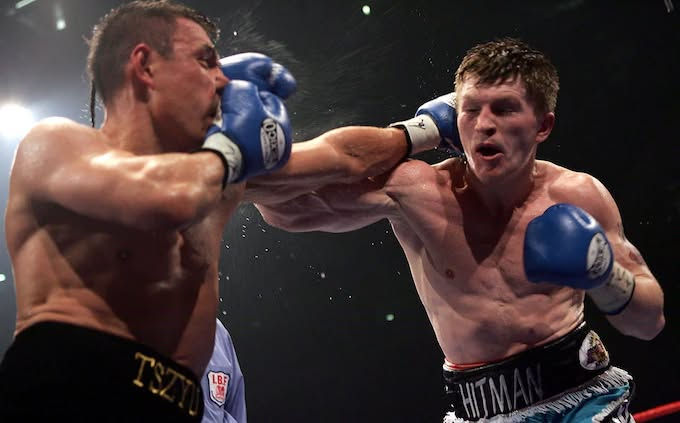
His finest hour came on June 4, 2005, at the MEN Arena in Manchester, where he took on one of the top pound-for-pound fighters in the world, Kostya Tszyyu, for the IBF and The Ring junior welterweight championship. The Russian-born Australian had been the first man to unify the light welterweight division in 30 years and, at 35 years old, had been the champion for more than a decade, losing just once before meeting Hatton.
Few gave Hatton a hope of winning. But in a fight scheduled for 2am UK time to suit the American audience, the 26-year-old was determined to prove that he belonged among the best. In front of 20,000 raucous supporters, the pair traded blows with a vicious intensity.
After an 11th round in which Tszyu sunk his much-feared right hand into Hatton and saw his opponent’s legs stiffen but not buckle, the champion sat on his stool battered, bruised and broken. Behind on all three judges’ scorecards, his trainer, Johnny Lewis, threw in the towel and Hatton fell to the canvas in disbelief before breaking down in exhausted, elated tears on the shoulder of his trainer Graham.
It is a moment that, in Britain at least, transcended boxing, becoming a moment of true sporting folklore. It reignited local interest in the sport and catapulted Hatton onto a whole new level of celebrity.
He went on to unify the division by beating Carlos Maussa a few months later before stepping up to welterweight to become a two-weight world champion, enduring a tough night in Boston against little-known Luis Collazo to win the WBA 147-pound crown. Some 18 months later, Las Vegas and Floyd Mayweather Jr came calling to present the opportunity of a lifetime for the British boxer.
Between 20,000 and 30,000 fans flocked to Vegas with Hatton. Many did not have tickets to the fight but still produced scenes the likes of which Sin City had never seen. At the weigh-in the day before the fight, all 6,000 seats at the MGM Grand Garden Arena were full two hours before the fighters stepped near the scales. Vegas might have been Mayweather’s home town but, for this weekend only, Hatton’s supporters had turned it into a mini-Manchester.
This time, however, there was no dream ending. Mayweather knocked down Hatton twice in the 10th round to inflict his first defeat. The loss hit Hatton hard physically and mentally, though few knew just how hard until many years later, when he started to speak openly about the battles with mental health that affected him following that first defeat.
In and out of the ring, he struggled to find any consistency. The highs of victories in front of his ever-loyal fans were followed by the lows of fractured relationships with his long-time trainer and best friend, Graham, and later, his parents. After Manny Pacquiao inflicted the second defeat of his career with a brutal knockout in their Las Vegas meeting in 2009, Hatton teetered on the edge.
For three years, Hatton remained inactive as a boxer, consumed instead by the demons that haunted him.
When he emerged from the darkness, he weighed over 15 stone (95kg) but boxing once again presented a light in the gloom. Hatton came out of retirement for his first fight in over three years against Ukrainian boxer Vyacheslav Senchenko in November 2012. Having shed around five stone to meet the welterweight limit of 67kg (10st 7lb), Hatton stepped into the ring hoping it would be the first step back to becoming a world champion again; to giving himself an ending that he could accept.
In the ninth round, Senchenko sunk a painful body shot into Hatton’s midriff that left the 34-year-old writhing on the canvas in agony. The dream was over.
He stayed in the sport, becoming a manager and trainer to many, and a friend and supporter to many more.
Hatton lived his life with great intensity and absolutely no filter. His propensity for binges meant that he looked prematurely aged by his early 40s, with grey hair and weathered skin, but he remained passionately devoted to his sport and to the stable of fighters he trained in Hyde. In July, he had even committed to a comeback this coming December against little-known Eisa Al Dah – an opponent of the same age – although it was unclear whether the bout would be granted professional status.
As we salute his memory, the nine-foot image of Hatton on the wall of his gym in Hyde will continue to recall the most glorious moments of a special career, surrounded as it is by posters of his bouts against Tszyu, Mayweather and Pacquiao. He was a formidable fighter and a true one-off.


Comments